Beginner
≈ 22 minSuggested range13 min – 36 min
Official LEGO® image · © LEGO Group and/or the respective rights holders. Source: LEGO Italy ↗
DUPLO · SET 10450
Hopsy's Castle Game
A colourful castle and illustrated board accompany Hopsy’s game.
- Pieces
- 47
- Release year
- 2025
- Theme
- DUPLO
- Set number
- 10450
- LEGO recommended age
- 3+
- LEGO retail price · Italy
- 39.99 €
Retail price reported by the LEGO source for the stated market. Check the store for current price and availability; this does not establish the launch price. LEGO ↗ · Reference checked on 26 October 2026
Official English name verified at: LEGO English catalogue ↗ · Checked on 26 October 2026.
TIME TO BUILD
How long does it take to build Hopsy's Castle Game?
For younger children, we estimate the first illustrated setup, with adult guidance when needed. Ranges reflect building familiarity, not a child’s age or ability. Free play and learning have no completion time.
Editorial estimate · first setup
Intermediate
≈ 15 minSuggested range9 min – 24 minExperienced
≈ 10 minSuggested range6 min – 16 minFirst guided arrangement: one model for 3 in 1 sets, a small composition for creative boxes, and setup alone for expansions. Excludes play, breaks and electronic configuration. These are broad editorial estimates, not measured times or targets to meet.
How we estimate times · sources and method
Editorial assessment of the first illustrated arrangement: A colourful castle and illustrated board accompany Hopsy’s game. The board adds a separate game phase; our estimate does not measure a round’s duration. For creative boxes this means one first small composition, for 3 in 1 sets only the main model, and for expansion sets their setup. An adult may guide the child. Ranges reflect building familiarity, not age or development; they do not measure play, learning or a speed contest. No verified timed build: indicative values with substantial variation.
Sources do not always specify the builder’s experience. The three experience bands are our editorial assessment, based on the complexity of the set and individual accounts where available.
- LEGO · set-specific instructions ↗
Official name, pieces, age and imagery; no timed building data.
- LEGO · set manual ↗
Document for this set number. The duration is an editorial estimate, not a LEGO timing.
Checked: 26 October 2026 · Method v1.0 · Limited reports; not a statistical average.
BUILT BY THE COMMUNITY
Yours could be the first building time.
0 reviewed solo building times.
No solo building times have been reviewed yet. You can still find editorial estimates under Suggested times.
Log your buildShare your building time · no account needed
Build your own story.
Save this set to your collection and track your progress. An account lets you keep your personal build history.
Create a free account →MAKE ROOM FOR YOUR NEXT BUILD
How much display space does it need?
Assembled-model dimensions are not yet documented for this set. Box dimensions cannot tell you how much display space it needs.
BEYOND THE BRICKS
Did you know?
Inside the set
A compact castle
Turrets and flags form an open front using a small number of large elements.
LEGO sourceBeyond assembly
The board adds a separate game phase; our estimate does not measure a round’s duration.
LEGO sourceBeyond the set
The stories, places and inventions behind your build.
Castles weren’t always stone
Many early Norman castles in England had a wooden tower on an artificial mound, the motte, beside a defended enclosure called the bailey. In some cases, stone structures replaced the original fortifications later.
Read the full story
English Heritage describes a motte as an earth mound topped by a timber tower, beside a defended enclosure. Early Norman castles were not all stone fortresses. At Totnes, wooden defences were replaced later: a castle could change materials and appearance during its lifetime.
Two walls could be better than one
In concentric castles, two fortified circuits supported each other. Breaching the outer wall didn’t mean taking the fortress: attackers still faced another defensive system.
Read the full story
Concentric castles had two mutually supporting rings of towered walls. Taking the first did not end a siege: attackers faced further defences section by section. English Heritage identifies thirteenth-century Dover as a leading English example. The arrangement served defence as well as creating an imposing silhouette.
Expanded stories updated on 29 October 2026
Written by HowLongToBuild · Sources are linked with each story · Checked on 26 October 2026. Historical facts and story details refer to the context described.
THE COMMUNITY’S EXPERIENCE
What was it like to build?
Three separate scores from 1 to 10. For difficulty, 1 means very easy and 10 means very difficult.
No approved ratings yet. Scores are never generated by this site or inferred from the recommended age.
Rate this set · no account needed
Building tips from the community
Specific steps, useful checks and sticking points. Contributions appear after moderation, in their original language. Do not upload instruction pages or personal contact details.
No approved tips yet.
Sign in to contributeSET THE MOOD
A soundtrack for your build
· Selected for the subject and atmosphere
Kiki’s music combines wonder with everyday gestures, accompanying the build’s fairytale character. This is an editorial mood pairing, with more understated choices for steps requiring attention.
OUR PICK
Kiki's Delivery Service (Original Sountrack)
Joe Hisaishi
Narrative and cinematicEditorial suggestions, not official soundtracks for the set. External services may require an account or subscription; editions and availability can vary by country. Suggest another soundtrack →
Report a problem with this set →
YOUR NEXT BUILD
You might also like
Sets from the same theme or with similar suggested building times. The ranges shown are for intermediate builders.
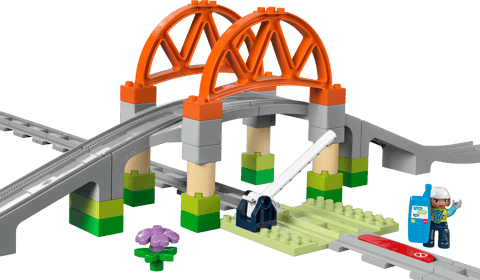
Official LEGO® image · © LEGO Group and/or the respective rights holders. Source: LEGO Italy ↗
Train Bridge and Tracks Expansion Set
42 pieces · 2+
9 min – 24 min
Suggested time · Intermediate
Same theme, a new build
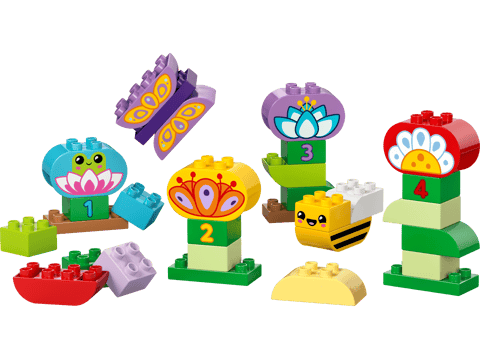
Official LEGO® image · © LEGO Group and/or the respective rights holders. Source: LEGO Italy ↗
Creative Garden & Flowers
45 pieces · 2+
9 min – 24 min
Suggested time · Intermediate
Same theme, a new build
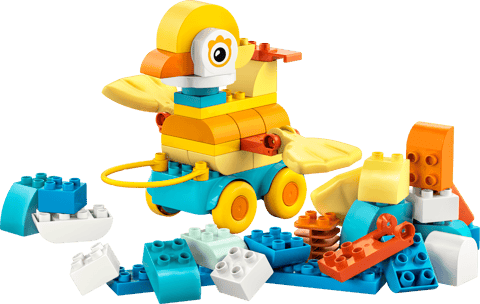
Official LEGO® image · © LEGO Group and/or the respective rights holders. Source: LEGO Italy ↗
3 in 1 Animals on Wheels
58 pieces · 2+
9 min – 24 min
Suggested time · Intermediate
Same theme, a new build