Beginner
≈ 10 h 30 minSuggested range6 h 45 min – 15 h 15 min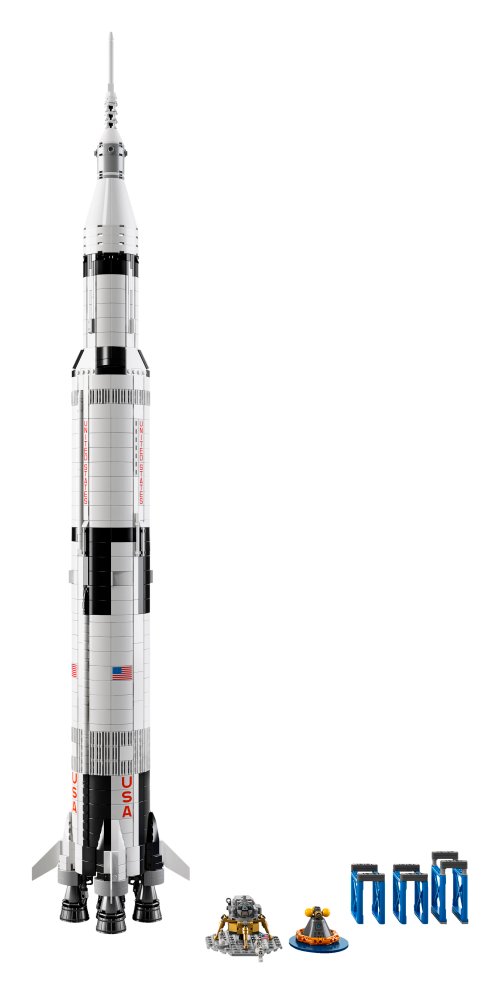
Official LEGO® image · © LEGO Group and/or the respective rights holders. Source: LEGO Italy ↗
Ideas · SET 21309
NASA Apollo Saturn V
The original 2017 Ideas edition of Saturn V: a nearly metre-tall rocket with separable stages that follows Apollo’s journey.
- Pieces
- 1,969
- Release year
- 2017
- Theme
- Ideas
- Set number
- 21309
- LEGO recommended age
- 14+
- Launch retail price · Italy
- 119.99 €
Retired from the LEGO Italy catalogue when checked on 24 October 2026. Availability can change. Check the store for the latest information.
Retail price announced at launch for the stated market; not a current offer. Launch price source ↗ · Reference checked on 27 October 2026
Official English name verified at: LEGO English archive ↗ · Checked on 24 October 2026.
TIME TO BUILD
How long does it take to build NASA Apollo Saturn V?
A starting point for planning your build. Times for each experience level are editorial estimates, not measurements submitted by HowLongToBuild users.
Editorial model estimate · no verified measured building time
Intermediate
≈ 7 h 15 minSuggested range4 h 30 min – 10 h 45 minExperienced
≈ 5 h 15 minSuggested range3 h 15 min – 7 h 45 minBased on one person building the set for the first time, following the original instructions and using numbered bags where supplied. Includes normal piece-finding and minor adjustments; excludes long breaks, filming, dismantling and modifications. Sources may use different methods. This range is neither a statistical interval nor a limit: your build may take less or more time.
How we estimate times · sources and method
The cylindrical structure, curved skin and stage connections reward an organised approach. Repeated assemblies still require careful alignment. Planning ranges are editorial allowances of roughly 65–145% of the central estimate, not guaranteed limits or measured averages.
Sources do not always specify the builder’s experience. The three experience bands are our editorial assessment, based on the complexity of the set and individual accounts where available.
- LEGO · model instructions and image ↗
Source for structure, pieces and components, not a measured building time. Experience-level times are editorial estimates.
Checked: 24 October 2026 · Method v1.0 · Limited reports; not a statistical average.
BUILT BY THE COMMUNITY
Yours could be the first building time.
0 reviewed solo building times.
No solo building times have been reviewed yet. You can still find editorial estimates under Suggested times.
Log your buildBuild your own story.
Save this set to your collection, track your progress and share your building time.
Create a free account →BEYOND THE BRICKS
Did you know?
Inside the set
The original 2017 edition
Set 21309 identifies the first Ideas edition. The later 2020 release 92176 has a separate record; choose the number printed on your box.
LEGO sourceA piece count that recalls Apollo
Its 1,969 pieces recall 1969, the year of the first human Moon landing. Separable stages help tell the mission’s story.
LEGO sourceBeyond the set
The stories, places and inventions behind your build.
Two spacecraft, different jobs
Eagle took Neil Armstrong and Buzz Aldrin to the lunar surface while Michael Collins remained in orbit aboard Columbia.
Read the full story
The vehicles later docked again. Their names help distinguish a mission architecture in which one part descended and another stayed above the Moon, supporting the crew’s eventual return.
A return journey for lunar material
Armstrong and Aldrin brought back roughly 21 kilograms of lunar rocks, recorded by NASA as 46 pounds.
Read the full story
The crew’s return also carried physical evidence for study on Earth. Apollo 11’s achievement therefore included scientific material, as well as the historic act of humans reaching the lunar surface.
A CLOSER LOOK
A rocket that shed weight on its journey
The Apollo Saturn V was not one enormous engine: it worked in three stages. Once a stage had used its propellant, it separated and the next took over. Leaving empty tanks and unnecessary structures behind meant accelerating a progressively smaller mass.
Read the full story
The version that launched Skylab had two stages instead. Saturn V therefore did not always mean the same configuration: the mission mattered too. The model’s separations offer a tangible way to recognise this logic, as well as a convenient way to display it.
Expanded stories updated on 29 October 2026
Written by HowLongToBuild · Sources are linked with each story · Checked on 24 October 2026. Historical facts and story details refer to the context described.
THE COMMUNITY’S EXPERIENCE
What was it like to build?
Three separate scores from 1 to 10. For difficulty, 1 means very easy and 10 means very difficult.
No approved ratings yet. Scores are never generated by this site or inferred from the recommended age.
Sign in or create an account to rate this set →Building tips from the community
Specific steps, useful checks and sticking points. Contributions appear after moderation, in their original language. Do not upload instruction pages or personal contact details.
No approved tips yet.
Sign in to contributeSET THE MOOD
A soundtrack for your build
· A pairing for this model
Suspended musical spaces and a sense of distance accompany missions, structures and cosmic landscapes. Apollo suits exploration and patient sessions, with curiosity and wonder.
OUR PICK
Apollo: Atmospheres and Soundtracks (Extended Edition)
Brian Eno, Daniel Lanois & Roger Eno
Intimate and spaciousA build to spread over several sessions: choose the more understated option when you want the instructions to take centre stage. The music does not set your pace.
Editorial suggestions, not official soundtracks for the set. External services may require an account or subscription; editions and availability can vary by country. Suggest another soundtrack →
Report a problem with this set →
YOUR NEXT BUILD
You might also like
Sets from the same theme or with similar suggested building times. The ranges shown are for intermediate builders.
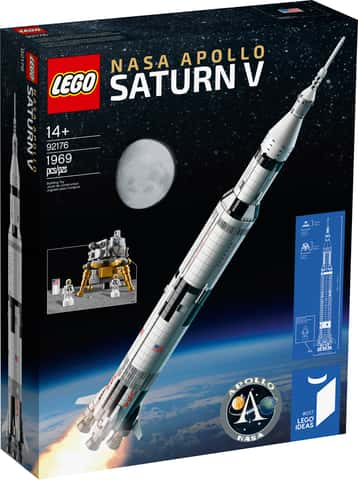
Official LEGO® image · © LEGO Group and/or the respective rights holders. Source: LEGO Italy ↗
NASA Apollo Saturn V
1,969 pieces · 14+
4 h 30 min – 10 h 45 min
Suggested time · Intermediate
Another journey into space
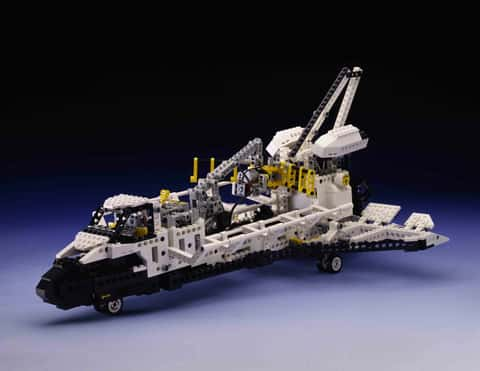
Official LEGO® image · © LEGO Group and/or the respective rights holders. Source: LEGO ↗
Space Shuttle
1,366 pieces · 11+
5 h 30 min – 12 h 30 min
Suggested time · Intermediate
Another journey into space
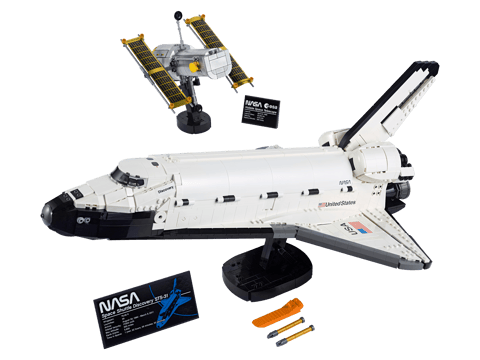
Official LEGO® image · © LEGO Group and/or the respective rights holders. Source: LEGO Italy ↗
NASA Space Shuttle Discovery
2,354 pieces · 18+
5 h 45 min – 13 h 15 min
Suggested time · Intermediate
Another journey into space